
Context
An acoustic materials company prepares treatment recommendations for projects based on architectural plans, room geometry, target RT60, and the acoustic performance of its materials.
For customers, this analysis is part of the buying process. A fast, clear, and technically grounded proposal helps them understand what treatment is needed, which materials are suitable, and how the room is expected to perform after installation.
Before this deployment, the acoustic study was a specialist-heavy manual workflow. The team had to inspect plans, identify rooms, calculate dimensions, estimate RT60 behavior across frequency bands, select treatment materials, compare options, and prepare proposal-ready recommendations.
Problem
Each study took around 4 hours. That time was not only an engineering cost. It was also a sales bottleneck.
When acoustic proposals depend on repeated manual calculations, the business has less capacity to respond quickly to new opportunities. Experienced people spend time recreating the same analysis steps instead of advising customers, improving proposal quality, or handling more projects.
The team needed a faster and more repeatable way to move from architectural plans to treatment recommendations without losing the acoustic logic behind the proposal.
What Guanta built
Guanta built a custom acoustic proposal configurator for the team.
The application allows the team to upload a plan, extract room geometry, assign room types and acoustic targets, calculate RT60 performance, and generate treatment proposals using the company’s acoustic materials.
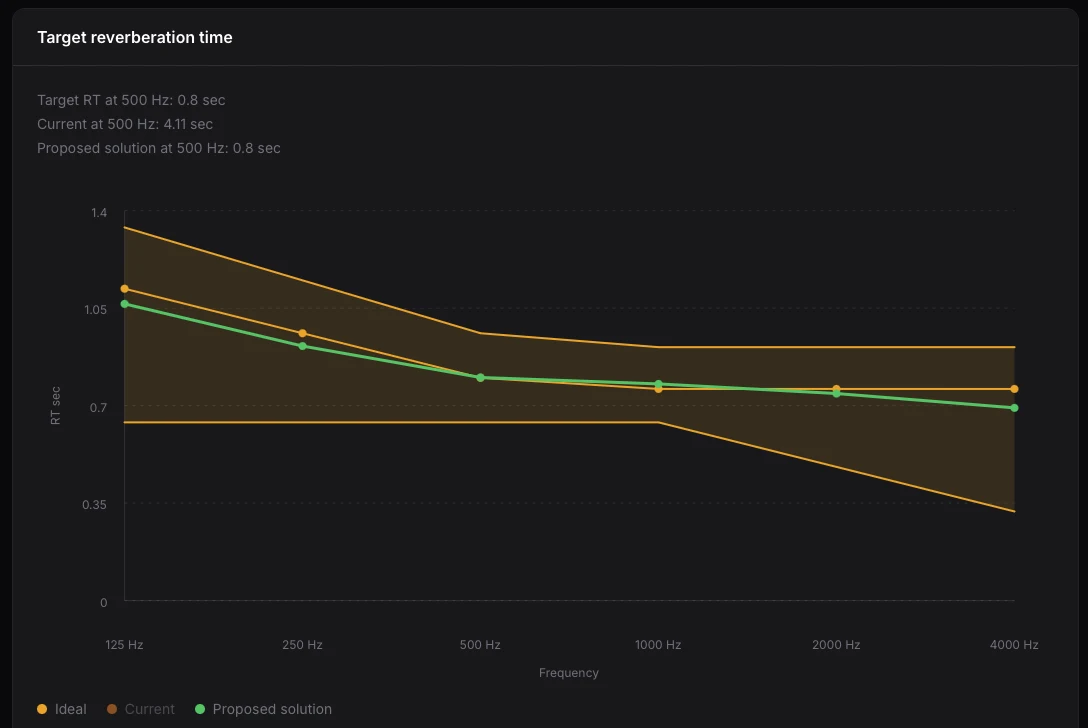
It uses AI to optimize proposed material combinations against the ideal RT60 curve for the intended room use, such as music, speech, meeting rooms, classrooms, or conference spaces. Instead of applying one generic acoustic target, the system evaluates how each proposal performs across frequency bands for the desired use case.
Instead of treating the tool as a simple calculator, Guanta designed it as a workflow application for sales and proposal operations. It helps the team move from technical inputs to proposal-ready options in one structured process.
How the workflow works
The configurator takes the room information from a plan and turns it into a treatment scenario.
Users can define the relevant room, review or adjust dimensions, select room type, set the intended use case, and compare material combinations. The system calculates RT60 across frequency bands, evaluates proposed treatments against the target curve, and presents options that can be shared with the client.
This makes the proposal process more consistent. The same calculation logic, material assumptions, and scoring approach can be applied across projects, while the team still keeps control over the final recommendation.
Outcome
The workflow moved from around 4 hours per acoustic study to about 4 minutes.
That is roughly a 60x improvement and saves about 236 minutes per study. More importantly, it turns a technical bottleneck into a scalable commercial workflow.
The business value is practical:
- reduced acoustic study time from 4 hours to 4 minutes
- faster client responses during the sales process
- standardized RT60 calculations and proposal logic
- less repetitive manual engineering work
- more consistent treatment recommendations
- easier comparison of material combinations against use-case-specific acoustic targets
- more sales capacity without increasing manual workload
Why it matters
Technical sales teams often depend on expert analysis before they can send a high-quality proposal. When that analysis is slow, sales velocity suffers.
This deployment shows how a custom application can turn specialist knowledge into a repeatable workflow. The company can respond faster, maintain proposal quality, and scale the commercial process while keeping acoustic expertise at the center of the final recommendation.