

Context
Medical device manufacturers need strong clinical evidence to support regulatory work, clinical evaluation, and product strategy. For many teams, building that evidence base is still a slow specialist workflow.
A reviewer starts with a device description and intended use, translates it into a PubMed strategy, builds MeSH-based queries, screens hundreds of abstracts, retrieves PDFs, classifies studies, checks relevance, appraises quality, and prepares regulatory documentation.
The work is important because it supports decisions that need expert judgment. But much of the process is repetitive, document-heavy, and difficult to repeat consistently across devices, indications, or updated searches.
Problem
For one medical-device evidence workflow, the manual process took around 30 days. Specialists had to move across search tools, article lists, PDF repositories, spreadsheets, appraisal notes, and regulatory document templates.
The team needed a faster way to build a defensible evidence base without turning the process into a black box.
They needed to know:
- which PubMed search strategy was used
- which articles were screened and why
- which publications contained clinical evidence
- which PDFs were retrieved and verified
- which full-text articles supported the intended use
- which studies belonged in PRISMA, PICO, and State of the Art outputs
- which decisions needed expert review before final documentation
Speed mattered, but traceability mattered just as much.
What Guanta built
Guanta built an AI-assisted clinical evidence workflow for medical devices.
The system starts with the device description and intended use, then helps generate an expert PubMed search strategy. It downloads and organizes articles, screens publications for regulatory relevance, classifies clinical and non-clinical evidence, manages PDFs, extracts full-text content, appraises evidence quality, and prepares structured outputs for review.
The goal is not to remove the regulatory specialist from the process. The goal is to give the specialist a faster, more consistent, and more auditable starting point.
How the workflow works
The pipeline turns clinical evidence work into a sequence of controlled steps.
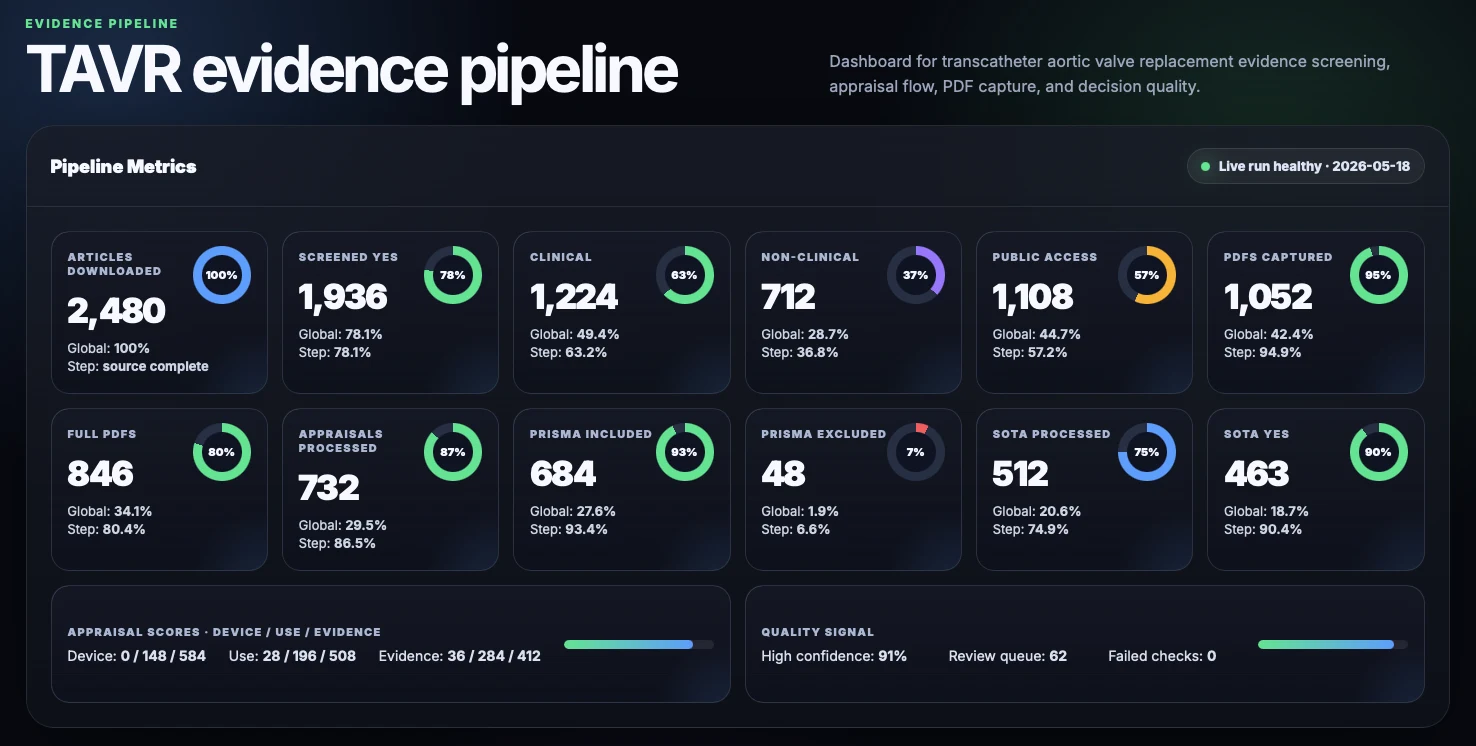
It searches PubMed, captures article metadata, downloads available PDFs, verifies full-text access, and screens each publication against the device, indication, and intended use. AI helps classify evidence, explain article-level decisions, identify inclusion or exclusion rationale, and assign evidence signals that reviewers can inspect.
The system also produces regulatory-ready structures: literature selection tables, PRISMA disposition, PICO extraction, State of the Art classification, appraisal summaries, and downloadable documents.
Each run keeps logs, article-level rationales, quality signals, and pipeline metrics, so the team can audit what happened and refine the review before anything is used as final regulatory evidence.
Outcome
The evidence workflow moved from roughly 30 days of manual effort to about 4 hours for an initial structured evidence package.
That time reduction gives medical device teams a faster way to start clinical evaluation work, update evidence reviews, compare device indications, and iterate across multiple pipeline runs.
The business value is practical:
- reduced evidence review cycle time from weeks to hours
- less repetitive abstract screening and PDF handling
- more consistent literature review structure across devices
- auditable article-level rationales and evidence scores
- faster generation of PRISMA, PICO, SOTA, and selection-table outputs
- more reviewer time spent on expert judgment and final decisions
Why it matters
Medical-device evidence work should be fast enough to support product and regulatory teams, but controlled enough for expert review.
This deployment shows how AI can help with the heavy operational work around clinical evaluation without replacing the manufacturer’s regulatory responsibility. The workflow gives teams a repeatable evidence pipeline, structured outputs, and traceability from search strategy to final review.
For manufacturers, the result is a better operating model: specialists keep control of the conclusion, while AI reduces the manual work required to reach a high-quality evidence starting point.