

Context
Compliance teams need to monitor a steady stream of official legal publications and government notices. For many organizations, this work is still manual: someone checks multiple sources, scans long lists of publications, decides what might apply to the company, and forwards relevant items to the right people.
In this deployment, the customer needed to follow sources such as BOE, DOGC, OJEU, and BOPB, then decide which new rules, notices, or obligations were relevant to each company under monitoring.
The existing process took roughly four hours per week. The work was necessary, but repetitive, noisy, and easy to delay when other compliance tasks became urgent.
Problem
The challenge was not only collecting publications. The harder problem was turning fragmented official sources into company-specific intelligence.
The team needed to know:
- which publications were new
- which notices were relevant to a specific company
- which regulatory area each notice affected
- which items needed review, assignment, or follow-up
- which stakeholders should be informed
- which notices had already been reviewed or dismissed
Without automation, people had to read through a large amount of irrelevant material before finding the few items that mattered.
What Guanta built
Guanta built a regulatory intelligence and compliance operations platform that monitors official publications, indexes notices, evaluates relevance with AI, and supports the review workflow around each decision.
The platform combines scheduled ingestion, company profiles, AI screening, workflow state, notice history, and email digests. Each company can be monitored according to its sector, activity, subscription scope, and company-specific answers.
Instead of asking users to search every source manually, the system continuously checks official publications in the background and flags notices that may apply to a company or regulatory area.
How the workflow works
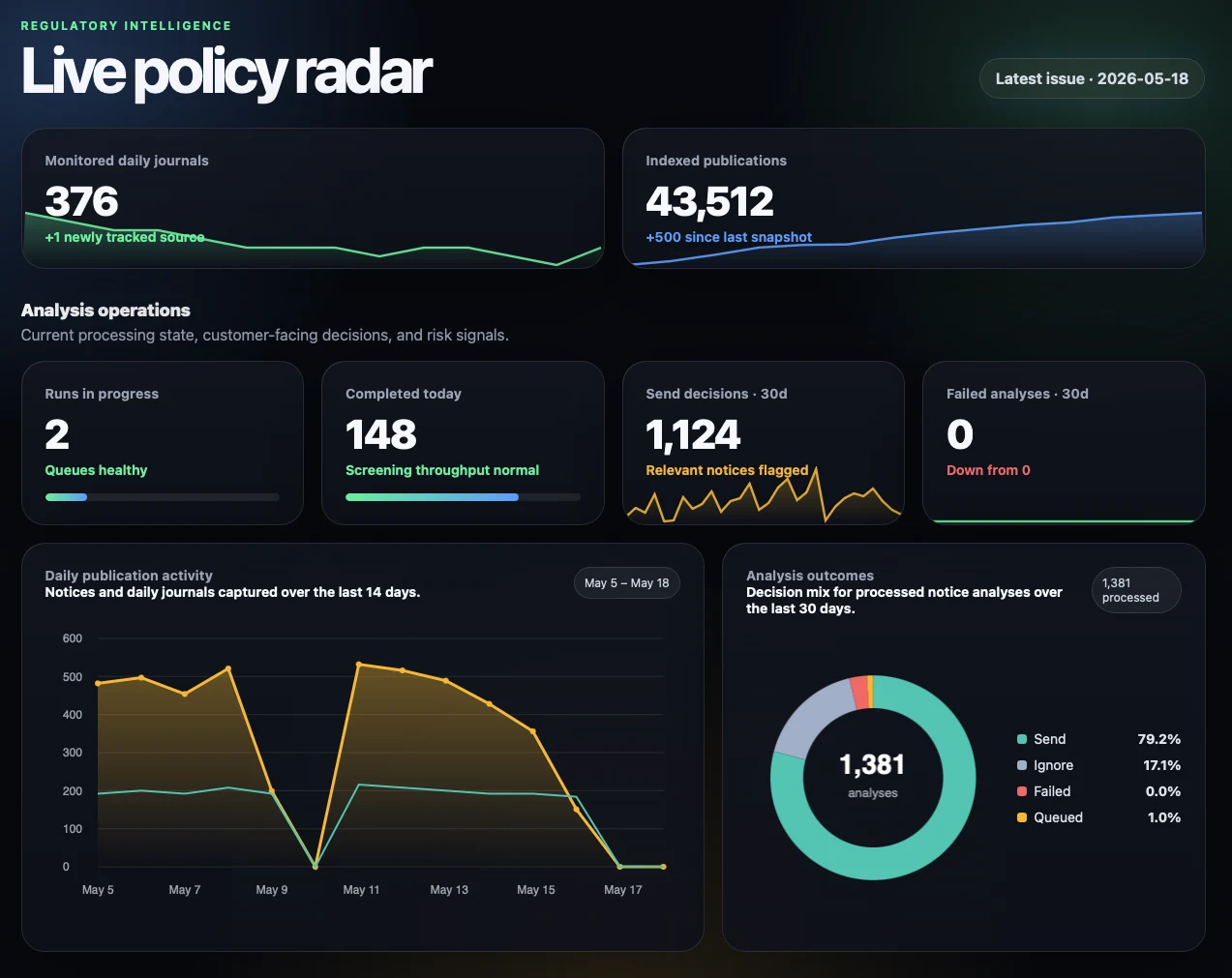
The system monitors official journals and public sources every day. New publications are indexed and analyzed against customer-specific monitoring profiles.
AI helps filter regulatory noise by deciding whether each notice should be sent, ignored, queued for later review, or marked as failed for operational follow-up. Compliance users can review decisions, confirm relevance, assign follow-up work, and track the resulting obligations.
Stakeholders receive a weekly summary of relevant items instead of manually checking sources. The notice history remains searchable, so teams can trace what was found, why it was flagged, and what happened next.
Outcome
The monitoring process moved from roughly four hours of manual work per week to a mostly automated background workflow.
Companies now receive alerts when a new law, rule, or government notice appears to apply to them. Compliance teams spend less time scanning official publications and more time reviewing the items that actually require judgment or action.
The business value is practical:
- reduced manual legal monitoring across fragmented official sources
- less noise from irrelevant publications
- faster response to new obligations
- company-specific monitoring instead of generic alerts
- searchable history for auditability and follow-up
- clearer assignment and tracking for compliance work
Why it matters
Regulatory monitoring is a good example of where AI is most useful in operations: not as a one-off assistant, but as part of a controlled process.
The value came from combining ingestion, AI relevance decisions, workflow state, human review, and stakeholder communication. The result was not just a smarter search tool. It was an operational system that turned official regulatory publications into actionable, company-specific compliance intelligence.