
Every company uses software.
There is usually an ERP somewhere. A CRM. A finance system. A customer support platform. A marketing stack. Industry-specific applications. Databases. Internal tools. Dashboards. Automation platforms. Shared drives. Messaging systems.
These applications are necessary. They store the records of the business and make many operations possible.
But they are not the whole story.
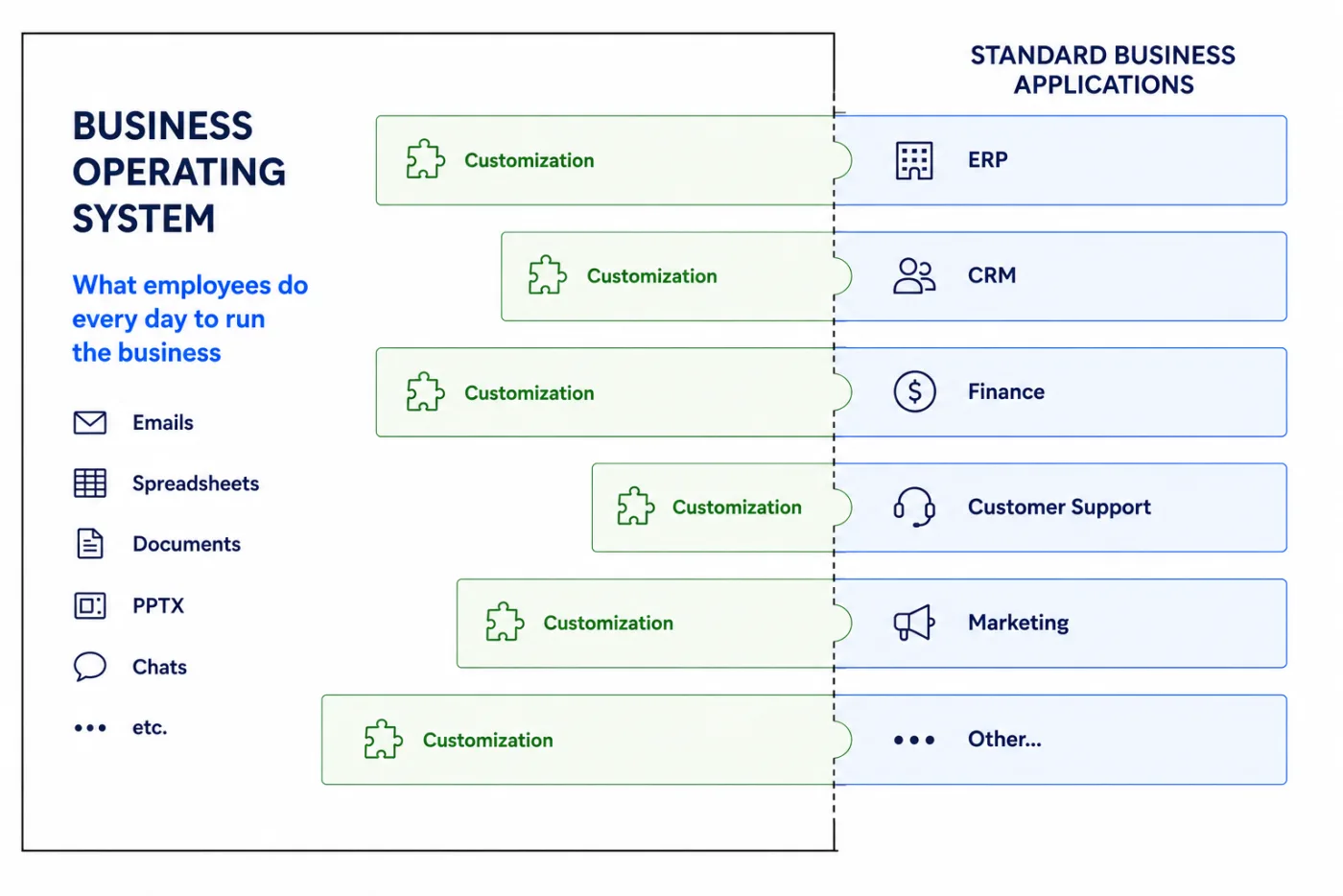
Most companies do not run only on their official software stack. They run on the work employees perform around that stack: exports, imports, reconciliations, approvals, status updates, spreadsheets, emails, documents, presentations, chats, forms, reports, exceptions, and decisions.
That repeated digital behavior is the real operating system of the company.
Standard software never fits perfectly
Business applications are designed to serve many companies. That is their strength, and also their limitation.
An ERP cannot fully encode how every company prices, purchases, manufactures, ships, bills, approves, forecasts, escalates, and reports. A CRM cannot fully capture how every sales team qualifies demand, handles exceptions, coordinates with finance, or prepares account plans. A support system cannot fully represent every policy, product edge case, customer history, or internal handoff.
So companies customize.
They add fields, workflows, permissions, dashboards, scripts, approval rules, integrations, and reports. They adapt the software to the business.
But even after all that customization, there is still a gap between the application and the way the company actually works.
That gap is usually filled by people.
An employee extracts data from one system, cleans it in a spreadsheet, asks a colleague for context, prepares a document, sends an email, waits for approval, updates a record, creates a presentation, posts a message in a channel, and then repeats some version of the same process next week.
This is not an exception. It is how modern companies operate.
The hidden operating system
In computer science, an operating system manages the resources of a computer. It coordinates the hardware, applications, memory, files, processes, permissions, and user interactions that allow the machine to work.
A company has something similar.
Its operating system is the set of workflows, decisions, controls, data movements, approvals, and routines that allow the organization to function.
Part of that operating system is visible in enterprise software. But a large part is hidden in everyday employee behavior.
It lives in the analyst who reconciles three exports before a forecast meeting.
It lives in the operations manager who checks exceptions, asks for missing information, and decides what can move forward.
It lives in the sales team that converts call notes, CRM data, contract terms, and pricing rules into a proposal.
It lives in the finance team that validates invoices against orders, contracts, and delivery evidence.
It lives in the compliance team that collects documents, reviews changes, assigns actions, and prepares evidence.
None of this may look like software architecture. But at company scale, it behaves like one. Inputs arrive. People process them. Rules are applied. Information moves. Decisions are made. Systems are updated. Outputs are produced.
The only problem is that much of this operating system is executed manually.
Physical work is a boundary, not a counterargument
This does not mean every activity in a company becomes software.
Airlines still need pilots. Hospitals still need nurses. Construction companies still need people on site. Restaurants still need kitchens. Factories still need physical operations. Logistics companies still need goods to move through the real world.
Physical work remains physical, and robotics is a different frontier.
But around almost every physical operation there is a large digital operation.
Flights require planning, scheduling, maintenance records, crew coordination, customer communication, disruption management, compliance documentation, billing, reporting, and exception handling.
Healthcare requires appointments, patient communication, clinical documentation, insurance workflows, inventory, billing, quality controls, and regulatory evidence.
Construction requires quotes, permits, procurement, drawings, change orders, schedules, safety checks, invoices, and progress reporting.
The point is not that AI eliminates physical work. The point is that the digital layer surrounding physical work is already enormous, and much of it is repetitive, document-heavy, system-mediated, and rule-driven.
That is the layer AI can transform now.
AI changes the economics of internal software
Historically, companies accepted manual digital work because building software was expensive.
If a process was messy, changed often, crossed too many systems, or required too much business judgment, it was easier to assign it to people than to automate it properly.
That tradeoff made sense when software was scarce.
AI changes the equation in two ways.
First, AI can perform parts of the work that traditional automation struggled with: reading documents, classifying requests, extracting structured information, comparing records, drafting messages, summarizing context, reasoning through exceptions, and deciding which tool should be called next.
Second, AI can help create software itself. Modern coding agents and AI-assisted development reduce the cost of building internal applications, integrations, workflows, data pipelines, and monitoring tools.
The result is important: the operating system of the company can become more programmable.
Instead of leaving the real process trapped in emails, spreadsheets, and employee memory, companies can turn repeated digital behavior into software that uses AI models when needed.
That software can call business systems. It can generate documents. It can route approvals. It can check policies. It can run predictions. It can prepare actions. It can escalate exceptions. It can log what happened.
The goal is not to replace judgment everywhere. The goal is to stop spending human judgment on work that is mostly coordination, formatting, checking, chasing, and copying.
More output, less manual coordination
This is why the AI conversation should not be reduced to “which jobs disappear?”
The deeper question is which companies become structurally more productive.
AI will force companies to produce more with less manual coordination. Not because every employee is replaced by a model, but because competitors will redesign their operations around software, data, and AI.
One company will still have people exporting reports, updating records, chasing approvals, and reconciling spreadsheets.
Another company will have those workflows running in the background, with humans reviewing exceptions, improving rules, making accountable decisions, and designing better systems.
Both companies may use the same foundation models.
The difference will be the operating system built around them.
The winning companies will not simply buy AI tools. They will turn their modus operandi into software.
From operators to builders
This also changes the role of employees.
In many companies, skilled people spend too much time acting as digital operators. They move information between systems. They prepare artifacts. They check whether the process is moving. They remind, reformat, reconcile, and re-enter.
Some of that work will remain. Some of it requires accountability, domain expertise, customer judgment, or context that should stay with humans.
But the center of gravity should move.
Employees should become more like builders of the operating system: defining processes, improving workflows, supervising agents, designing controls, validating outputs, measuring results, and deciding where automation should or should not act.
That does not mean every employee becomes a software engineer. It means more employees participate in shaping how the company works, instead of only executing the work manually.
The companies that make this transition well will compound faster. Every improved workflow becomes reusable. Every automated check reduces future friction. Every observable process becomes easier to improve. Every exception teaches the system.
What an AI operating system needs
An AI operating system is not a single application.
It is a layer of software, agents, data pipelines, integrations, controls, observability, and machine learning around the real processes of the company.
It needs access to business systems, but it should not be trapped inside one vendor’s application.
It needs agents that can execute work, but also controls over what they are allowed to do.
It needs AI models for language, reasoning, extraction, classification, and generation, but also conventional software for deterministic logic, permissions, workflows, and data quality.
It needs machine learning where prediction matters: demand, risk, churn, fraud, prioritization, inventory, timing, pricing, and capacity.
It needs observability: what triggered the workflow, what data was used, which model was called, which tools were invoked, what changed, who approved it, what failed, and what business outcome followed.
And it needs people close to the business who can translate messy operational reality into systems that actually work.
Where Guanta fits
Guanta helps companies build this AI operating system.
We work on the layer between standard business applications and the real digital work employees perform every day.
That means building agents that use company context and tools. Connecting workflows across systems. Creating custom applications where packaged software does not fit. Adding observability so teams can see what happened. Using machine learning where predictions can improve operations. And bringing forward-deployed engineering close to the business process, so the solution reflects how the company actually works.
The objective is not to add another dashboard or another chatbot.
The objective is to make the company itself run better.
AI will not transform every company in the same way. Some organizations will use it as a layer of assistance on top of the same manual operating model. Others will use it to rebuild the digital operating system underneath the business.
Those are the companies that will produce more, learn faster, and adapt with less friction.
Every company already has an operating system.
The question now is whether it remains hidden in manual work, or becomes software.