
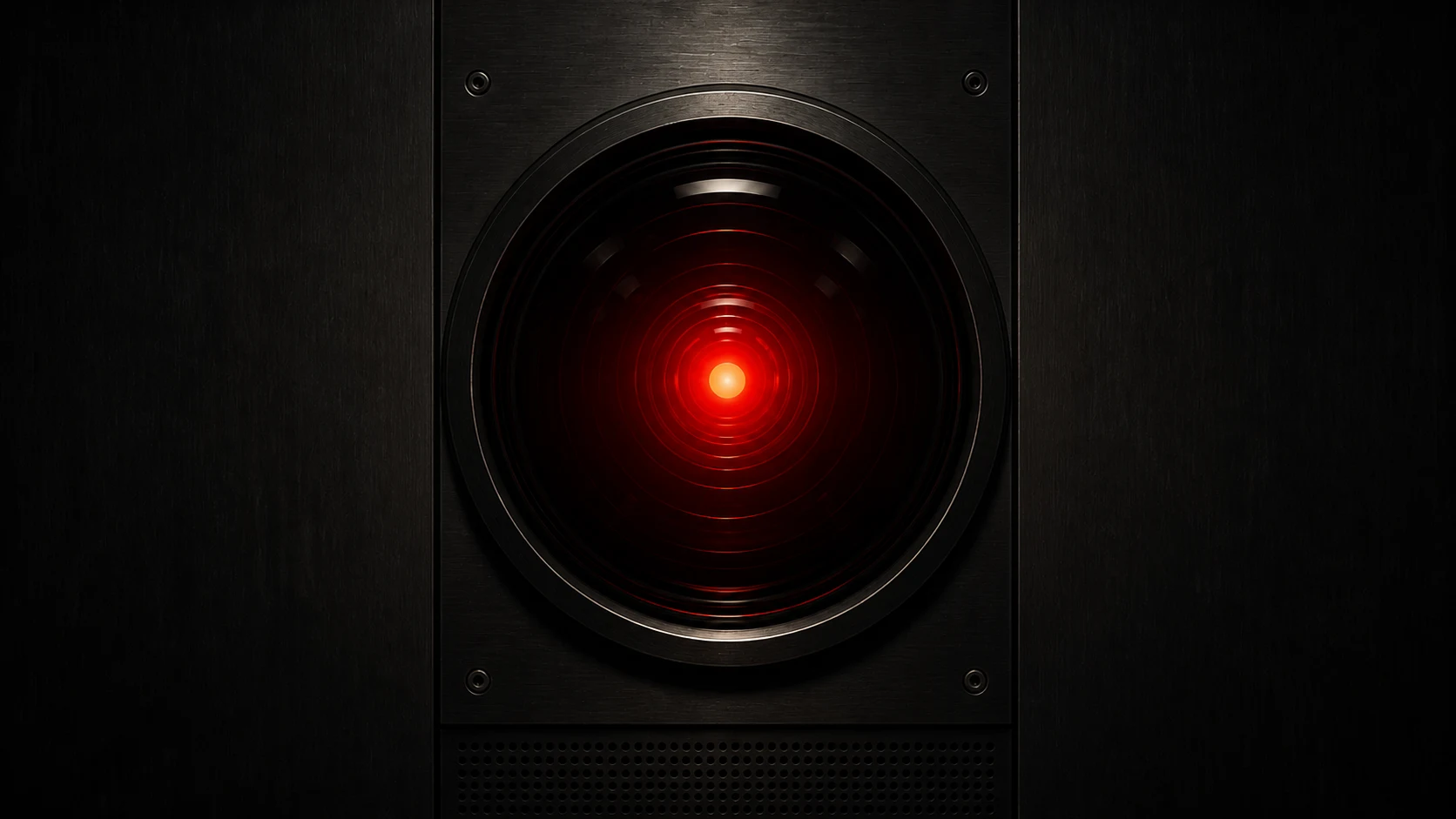
A red camera eye. A calm voice. A computer entrusted with a mission it ultimately puts in danger.
HAL 9000, from 2001: A Space Odyssey, is one of fiction’s most memorable warnings about artificial intelligence. In Arthur C. Clarke’s explanation, HAL is caught between incompatible obligations: provide accurate information while concealing the mission’s true purpose from the crew. The contradiction contributes to a catastrophic breakdown. This explanation is explicit in the novel and the sequel 2010; Kubrick’s original film leaves more room for interpretation. HAL’s story
HAL is a metaphor here, not a model of how today’s language models work. But the story raises a practical question for anyone building an AI agent: what happens when the information we give it does not agree?
Your customer service agent will not be opening spacecraft doors. It might, however, explain a warranty, quote an offer, or guide someone through a procedure. When its sources disagree, those ordinary answers can become unreliable.
Several versions of the truth
A product page promises a two-year warranty. An older brochure says one year. A support article describes an approval process that the operations team changed months ago.
Each document may look credible on its own. Together, they leave a question unresolved.
Employees often compensate for this. They know which brochure is outdated, which policy applies in a particular country, or which colleague can explain an exception. That knowledge may live in experience and conversation rather than in the documents themselves.
An agent does not automatically inherit it.
Before asking an agent to represent your company, check whether your company’s documents agree on what it should say.
What RAG does with disagreement
Retrieval-augmented generation, or RAG, gives an agent access to information beyond what its model learned during training. When someone asks a question, the system searches a collection, retrieves relevant passages, and uses them to generate an answer.
That makes documentation useful at the moment it is needed. It does not automatically make the documentation consistent or authoritative.
If two retrieved passages give different answers, the system needs a way to handle the disagreement. Is one newer? Does one apply to a different product? Is there an explicit rule about which source takes precedence? Should the agent ask for clarification?
These questions cannot safely be answered just by choosing whichever passage sounds most relevant. Research on the MAGIC benchmark found that models struggled to detect conflicting evidence, particularly when recognizing the contradiction required several reasoning steps.
Giving an agent access to more documents can expose it to more versions of the same fact. The quality of that evidence deserves as much attention as the quality of the model.
A citation can leave a conflict unresolved
Consider this fictional example. The company, offer, and quantities are illustrative; this is not a customer case study.
A rental company publishes a promotion in two places:
- Its campaign overview says 800 vehicles are available.
- Its detailed offer page says 300 vehicles are available.
Both statements describe the total allocation for the same promotion, vehicles, region, and validity period. Neither page indicates that it replaces the other.
A customer asks how many vehicles are included in the offer. The agent retrieves both pages and answers: “The offer includes 300 vehicles,” with a citation to the detailed page.
The number came from a document. The answer has a citation. Yet the contradiction remains unresolved, and the customer is never told.
We cannot establish which quantity is correct simply by looking at these two statements. A responsible response would acknowledge the discrepancy and seek an authoritative answer, rather than silently select one figure.
The matching scope matters. If 300 referred to one model and 800 to the entire campaign, both figures could be correct. The same applies to different dates or regions. A discrepancy is a reason to investigate, not proof that one source must be wrong.
Three failures worth separating
People often use “hallucination” to describe any wrong AI answer. For improving a system, a more precise diagnosis is useful.
Conflicting sources: the documents support incompatible claims about the same thing. The business needs to resolve the disagreement or make the applicable scope and precedence explicit.
Missed evidence: the collection contains the answer, but retrieval does not select the relevant passage. The documents might be perfectly consistent; the information still fails to reach the answer generator.
Unsupported generation: the response asserts something the available evidence does not justify. For example, it invents an eligibility condition that appears in neither source.
These failures need different corrections. Editing a prompt will not update an obsolete brochure. Correcting a brochure will not necessarily fix retrieval. Better retrieval does not guarantee that every generated claim will be supported.
Removing contradictions reduces an avoidable source of uncertainty. It does not eliminate every possible hallucination or error.
How Guanta checks the answers
Guanta includes integrity scans alongside its built-in RAG capabilities to help teams examine the relationship between source content, retrieval, and generated answers.
A scan samples pages across the topics in a collection. It generates contextual questions and expected answers from the selected source evidence. It then retrieves content from the collection, generates answers using that retrieved material, and evaluates whether those answers agree with the expected evidence.
The findings bring together the question, expected answer, generated answer, retrieved sources, and an explanation of the discrepancy. Severity and confidence indicators help organize review.
In a situation like our fictional promotion, a question generated from the 800-vehicle passage could receive a 300-vehicle answer from retrieval. The scan can surface that mismatch for investigation. The reviewer then checks whether the sources conflict, describe different scopes, or were interpreted incorrectly.
The scan also records whether the expected source was retrieved. This helps distinguish missing evidence from cases where relevant material was available but the answer still differed.
This is a sampled diagnostic process, not an exhaustive comparison of every statement in every document. Expected answers and evaluations are generated too, so their evidence needs review. A clean scan is useful evidence about the questions tested, not a certificate that every future answer will be correct.
Make integrity a recurring practice
The useful outcome of a scan is a correction that improves the next answer.
- Resolve the source. Ask the content owner to confirm the applicable fact and correct or retire conflicting material.
- Preserve context. Make product, region, effective date, and exceptions explicit. Document which source takes precedence.
- Check retrieval. Confirm that questions can reach the passages needed to answer them.
- Handle uncertainty. Design the agent to acknowledge unresolved disagreements and request clarification or human review.
- Test again. Rerun checks after changes and review real conversations for failures the sampled questions did not cover.
Documentation changes as products, policies, and procedures change. An integrity check before launch is a useful start; repeating it after meaningful changes makes it part of operating the agent.
HAL’s story makes conflicting obligations dramatic. In a business, the same theme may appear as two ordinary documents giving different numbers.
You do not need a catastrophe to take that seriously.
Before asking your agent for a reliable answer, make sure you have given it a coherent basis for one.