
For the last two years, most companies have approached AI as an employee productivity tool.
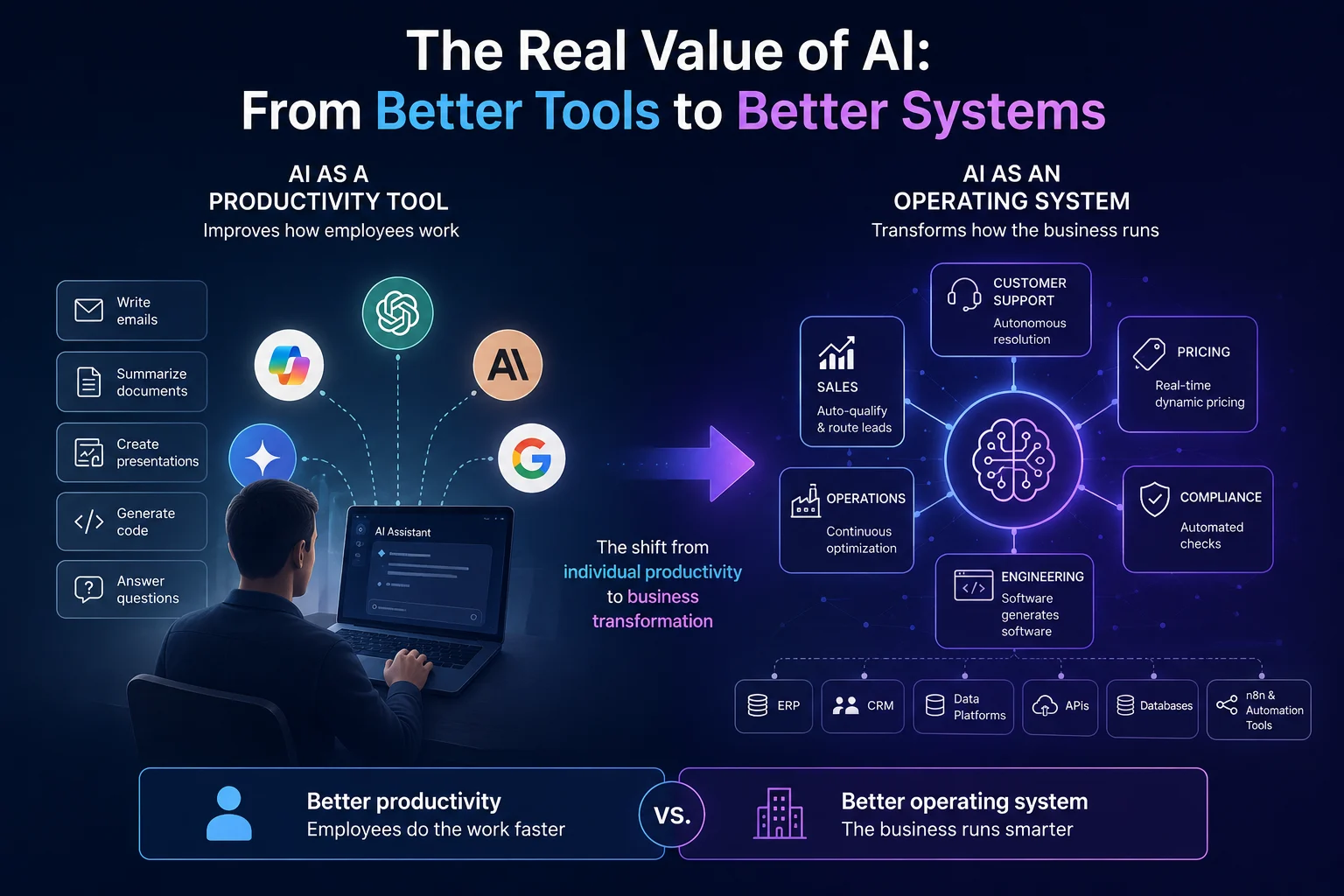
They buy licenses for ChatGPT, Microsoft Copilot, Claude, Gemini, and other AI assistants. They encourage employees to use these tools to write emails, summarize documents, create presentations, analyze data, and generate code.
That is useful. It can create real productivity gains. It can help people move faster through everyday work.
But it also misses the larger opportunity.
The real value of AI is not building a better chatbot for every employee.
The real value of AI is building a better operating system for the company.
Every company already has an operating system
A corporate operating system is the combination of software, workflows, data, decision-making processes, approvals, controls, and automation that allows a company to function.
Every organization already has one.
Part of that operating system lives inside enterprise software: ERP systems, CRM platforms, accounting applications, manufacturing systems, compliance systems, and industry-specific tools. Another part lives in workflow and integration platforms such as n8n, Make, Zapier, Workato, and other automation tools that move information between applications.
Together, these systems form the visible digital backbone of the organization.
But a surprisingly large part of how companies actually operate lives outside those systems.
It lives in emails, spreadsheets, folders, documents, meetings, approvals, manual data entry, status updates, and countless informal workflows that employees execute every day.
Historically, this was a rational tradeoff.
Building custom software was expensive. Buying software was expensive. Integrating systems was expensive. Maintaining custom workflows was expensive.
So companies automated only a subset of their operations and relied on people to bridge the gaps between systems.
Humans became the middleware.
Human middleware was a software economics problem
Employees copy and paste information from one application to another. They chase approvals through email. They update spreadsheets, generate reports, validate data, coordinate teams, manage exceptions, reformat outputs, and check whether one system agrees with another.
Most of this work is not strategic. It is connective tissue.
For a long time, that made economic sense. The cost of software often exceeded the cost of keeping people in the loop. If a process was messy, changed frequently, or crossed too many systems, it was easier to assign the work to an employee than to build a custom application.
That equation is now changing.
Modern AI systems and code-generation tools are dramatically reducing the cost of creating and maintaining software. Processes that previously required months of development and large implementation budgets can increasingly be automated with a fraction of the effort.
For decades, software was the scarce resource and human labor compensated for its limitations.
Today, software is becoming abundant.
The expensive part is no longer just building applications. The expensive part is having skilled employees spend their time executing repetitive, predictable processes that software could perform automatically.
Productivity is the small prize
Giving employees AI assistants improves individual productivity. That matters, but it is not the transformation.
If an employee uses AI to write a report faster, the report still has to be requested, prepared, reviewed, sent, filed, and acted on. If a salesperson uses AI to summarize a call, someone still has to update the CRM, qualify the opportunity, route the next step, notify the right team, and check whether the account fits the company’s rules. If a compliance analyst uses AI to summarize a regulation, someone still has to map the change to internal controls, assign actions, collect evidence, and prepare an audit trail.
In each case, the employee moves faster, but the process remains largely intact.
That is why productivity alone is the small prize. It optimizes the person inside the existing operating model.
The bigger opportunity is to change the operating model itself.
Instead of asking how AI can help an employee perform a task faster, companies should ask which tasks should disappear from the employee’s workload entirely.
- Which handoffs can be automated?
- Which checks can run continuously?
- Which decisions can be prepared in the background?
- Which exceptions should be routed automatically?
- Which reports should generate themselves?
- Which workflows should become software?
Two companies, same models, different outcomes
Consider two competing companies.
The first company gives every employee access to the latest AI chatbot. Employees work faster, write better reports, and spend less time on repetitive tasks. AI adoption is visible across the organization, but most workflows still depend on people moving work from one place to another.
The second company uses the same AI models, but embeds them directly into business processes. Customer support is partially autonomous. Sales opportunities are automatically qualified and routed. Pricing decisions adapt with better data. Supply chains are continuously monitored. Compliance checks happen automatically. Software generates software. Routine work runs in the background, and people focus on exceptions, judgment, and improvement.
Which company will have the larger advantage?
The answer is obvious.
The first company improves individual productivity.
The second company transforms how the business operates.
Competitive advantage comes from redesigned systems
History suggests that the largest competitive advantages rarely come from giving workers better tools. They come from redesigning systems.
- The assembly line was not simply a better hammer.
- ERP systems were not simply better spreadsheets.
- E-commerce was not simply a better catalog.
In each case, the winners changed the operating model itself. They reorganized work around a new technical possibility, then built processes, data flows, roles, and controls around that new model.
AI represents a similar shift.
As foundation models become increasingly available and commoditized, access to AI will stop being a differentiator. Every serious company will have access to powerful models. Every company will have access to AI coding assistants. Every company will have access to automation tools.
The differentiator will be how effectively companies combine these technologies into an operating system tailored to their business.
That operating system will not be a single product. It will be a layer of software, workflows, integrations, models, controls, data pipelines, and observability that reflects how the company actually creates value.
The companies that build this layer well will move faster because the company itself will be faster.
The new corporate operating system
An AI-powered operating system is not a chatbot with more permissions. It is a managed way to run business processes with software, data, automation, and AI working together.
It needs clear inputs: emails, forms, records, documents, messages, customer events, system updates, or external data.
It needs defined outputs: updated records, routed cases, generated reports, prepared quotes, approved actions, escalated exceptions, customer responses, or evidence trails.
It needs controls: permissions, approval steps, policy checks, audit logs, security boundaries, and human review where the risk requires it.
It needs observability: what happened, which data was used, which model was called, which tools were invoked, what changed, who approved it, and what business outcome followed.
And it needs continuous improvement. When the process fails, the company should be able to identify why, improve the workflow, and measure whether performance actually improved.
This is very different from telling employees to experiment with prompts.
Prompting is a skill. Operating system design is a business capability.
The work of the next decade
The next generation of companies will not merely add AI to the edge of existing workflows. They will rebuild workflows around AI, software engineering, and modern foundation models.
They will turn repeated manual processes into reusable systems. They will reduce the amount of work that depends on someone copying, checking, chasing, reformatting, or reconciling information. They will make more operations measurable, observable, and improvable.
That does not mean the central question is which employees will be fired because of AI. The larger question is which companies will become structurally stronger because they redesign how work happens.
AI will not affect every company in the same way. Some organizations will use it as a layer of assistance on top of the same slow processes. Others will use it to build operating systems that are more precise, more automated, and more adaptive.
That difference will show up in the numbers. Companies with better-designed operating systems will respond to customers faster, qualify demand more accurately, reduce avoidable costs, improve margins, shorten cycle times, catch operational issues earlier, and scale without adding the same amount of headcount or management overhead.
In that sense, AI competition will not only be about model access or employee productivity. It will be about how finely tuned the operating system of the company becomes.
People still matter. But their work moves toward the parts of the business where human judgment actually matters: strategy, relationships, exceptions, creativity, accountability, and process design.
The future does not belong to organizations where employees spend the most time chatting with AI.
It belongs to organizations that systematically rebuild their processes around AI, software, and data.
ChatGPT made employees faster, AI-powered operating systems make companies stronger.