

The advantage is moving from models to implementation
AI implementation is becoming more competitive. Many teams now have access to strong models, agent frameworks, code generation, vector databases, workflow tools, and cloud infrastructure.
That access matters, but it is not enough to create durable advantage.
The hard part is no longer only building a demo. A demo can show an agent answering a question, extracting fields from a document, calling a tool, or drafting a report. The harder problem is turning that capability into a workflow that a real organization can trust, operate, measure, and improve.
That work is specific. It involves customer systems, permissions, data quality, legacy processes, edge cases, governance, human review, and adoption. It requires technical judgment and field judgment at the same time.
This is why the competitive advantage for an AI implementation company will increasingly come from its forward-deployed engineering capability.
Not just whether it has FDEs.
Whether it can hire them, train them, coach them, support them with the right platform, and turn what they learn in the field into reusable product leverage.
FDEs are not just delivery people
A weak version of forward deployment treats FDEs as technical implementers who arrive after the sale and make the software work.
That misses the point.
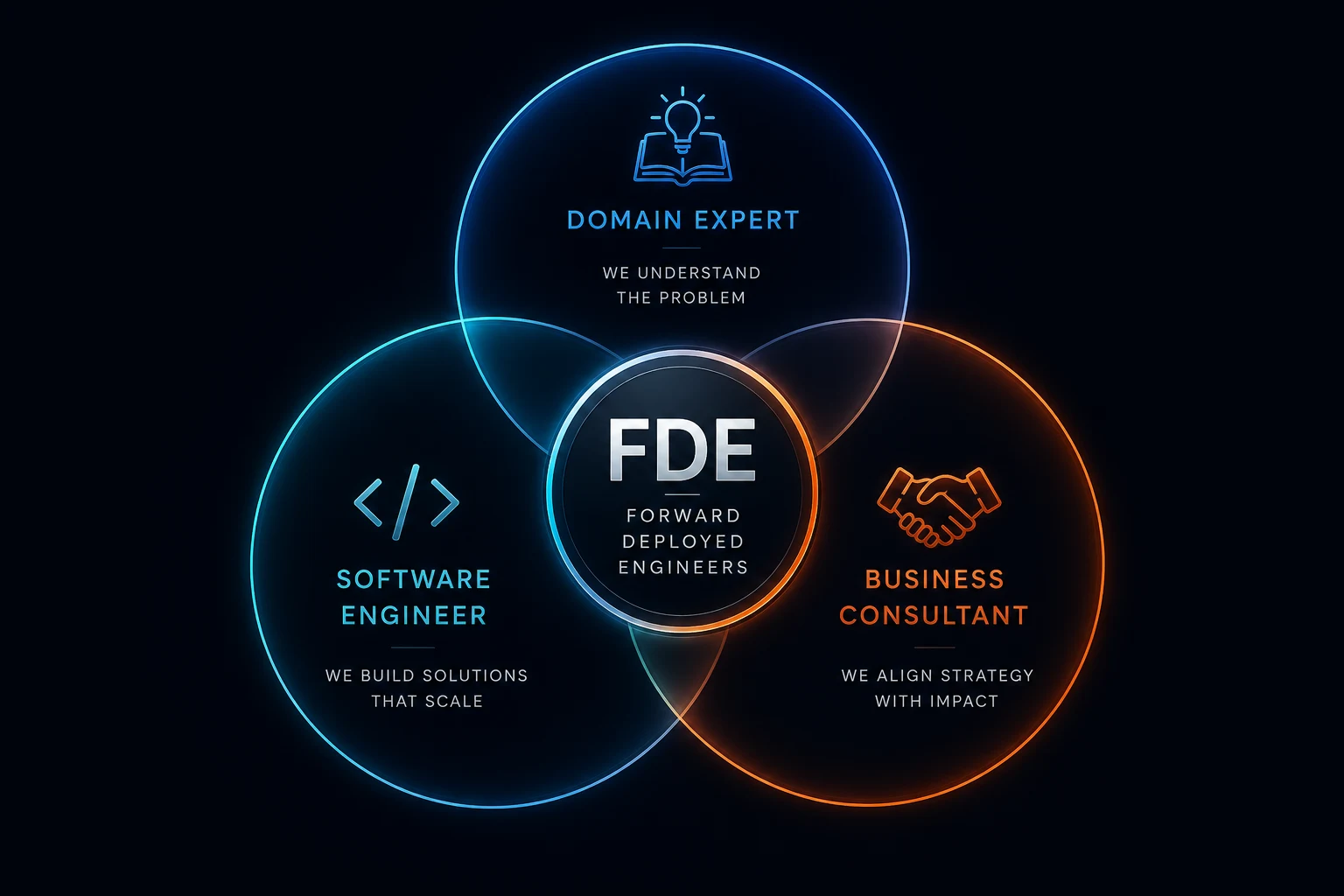
In AI, a strong forward-deployed engineer is a product discovery engine, implementation engineer, customer translator, and internal teacher. They sit close enough to the customer to understand how work actually happens, and technical enough to turn that understanding into software.
They do the work that cannot be captured in a requirements document:
- notice which workflow matters most
- find the gap between the documented process and the real process
- identify where users trust automation and where they need review
- understand which system is authoritative when records conflict
- turn messy operational knowledge into agent tools, data models, and controls
- detect which customer-specific work should become reusable platform capability
That last point is critical. FDEs should not only deliver value to one customer. They should teach the company what the product needs to become.
The best FDEs compress complexity
Enterprise AI projects contain a lot of hidden complexity. The model is one part of the system. The process around the model is usually larger.
A production AI workflow may need authentication, permissions, integrations, state, audit history, prompt management, retrieval, evaluations, human approvals, observability, scheduled execution, exception handling, and reporting.
The customer does not always describe that system clearly. Often they cannot, because the process is distributed across people, spreadsheets, tools, habits, and exceptions.
The FDE’s job is to compress that complexity into something buildable.
They translate an operational problem into a first deployment. They decide what can be automated now, what needs a human review step, what should be measured, and what should remain outside the first scope. They also help the product team understand what part of the field solution is a one-off and what part is a reusable platform primitive.
That compression is rare. It is a skill companies have to cultivate deliberately.
The moat is institutional, not heroic
It is tempting to describe great FDEs as heroic individuals. Some are. But a serious AI implementation company cannot rely only on heroics.
The real moat is institutional.
It is the system around the FDE:
- how the company hires for technical speed, customer judgment, and resilience
- how new FDEs learn the platform and the deployment method
- how senior people coach field teams through ambiguous customer situations
- how field patterns are documented and reused
- how product teams receive, prioritize, and generalize field learning
- how quality is reviewed before deployments become production systems
- how customer success, engineering, product, and leadership stay aligned around outcomes
Without that system, forward deployment becomes expensive custom work.
With that system, each deployment trains the company.
Training matters because the role is unnatural
Forward-deployed engineering asks for a strange combination of skills.
The FDE needs to write useful software quickly, but not disappear into pure engineering. They need to talk with users, but not become a passive note-taker. They need to respect customer constraints, but not simply build whatever the customer asks for. They need to move fast, but not create uncontrolled operational risk.
That combination is not common.
Good FDE training should teach people how to:
- discover workflows by watching work, not only by collecting requirements
- choose a first deployment small enough to launch and valuable enough to matter
- build on the platform instead of creating unnecessary one-off code
- add observability and review paths before the workflow becomes critical
- separate customer-specific configuration from productizable patterns
- communicate tradeoffs clearly to both customer stakeholders and internal product teams
Coaching matters too. Many FDE decisions are judgment calls. The best way to improve judgment is to review real deployments, discuss what worked, identify what should have been generalized, and make the next deployment better.
The platform has to make FDEs stronger
The relationship between platform and FDE team cuts both ways.
FDEs make the platform better by discovering real customer problems. But the platform also has to make FDEs better by giving them leverage.
If every deployment starts with a blank repository, the company is doing consulting. If every deployment requires a large custom engineering effort, margins will suffer and learning will fragment.
A strong AI implementation platform should give FDEs reusable building blocks:
- agent configuration and execution
- knowledge and retrieval management
- tool definitions and integrations
- database and workflow state
- authentication and permissions
- traces, evaluations, and observability
- scheduled and background execution
- human review and approval flows
- AI-assisted development for missing workflow components
The platform does not remove the need for FDEs. It makes each FDE more effective.
That is the compounding loop: the field team finds the real problems, the platform absorbs what repeats, and the next deployment starts from a stronger base.
The danger is the services trap
There is a real failure mode here.
An AI implementation company can become a services business with modern language around it. It can build custom workflows for each customer, celebrate short-term wins, and never turn those deployments into reusable capability.
The difference between a moat and a trap is product leverage.
After each deployment, the company should ask:
- What did we build that will help the next customer?
- Which connector, tool, evaluation, prompt pattern, data model, or review flow should become reusable?
- Which part of the deployment was truly customer-specific?
- Did the FDE team use the platform more effectively than last time?
- Did the product team learn something it could not have learned from a sales call?
- Will the next similar workflow be faster, safer, or easier to observe?
If the answers are weak, the company is accumulating custom work.
If the answers are strong, the company is building an implementation advantage.
Customers are buying a deployment function
This also changes how customers should think about AI implementation partners.
They are not only buying software. They are not only buying consulting hours. They are buying a deployment function that would be hard to assemble internally.
Hiring one good FDE is difficult. Hiring several, training them on a coherent platform, coaching them through real enterprise deployments, and connecting their learning back into product is much harder.
For many customers, that capability is more valuable than a generic AI tool. The customer wants production outcomes, not another prototype. They need someone who can turn the messy reality of their process into something that runs.
That is why FDE capability can become a durable advantage for the implementation company and a practical advantage for the customer.
Where Guanta fits
Guanta is built around this platform-plus-field model.
The platform provides the reusable production layer: agents, observability, security, database, integrations, execution, and AI-assisted development for custom workflow pieces.
The services layer brings forward-deployed engineering capability: people who can work with the customer to understand the process, extend the platform, connect systems, add controls, and launch a workflow that can be measured.
The goal is not to replace software with open-ended consulting. The goal is to make AI deployable in the places where the standard product is not enough yet, while making the platform stronger with every deployment.
For AI implementation companies, the next advantage will not come only from having access to better models. Many teams will have that.
The advantage will come from building the organization that can repeatedly turn AI capability into production workflows.
That organization will need excellent forward-deployed engineers.