

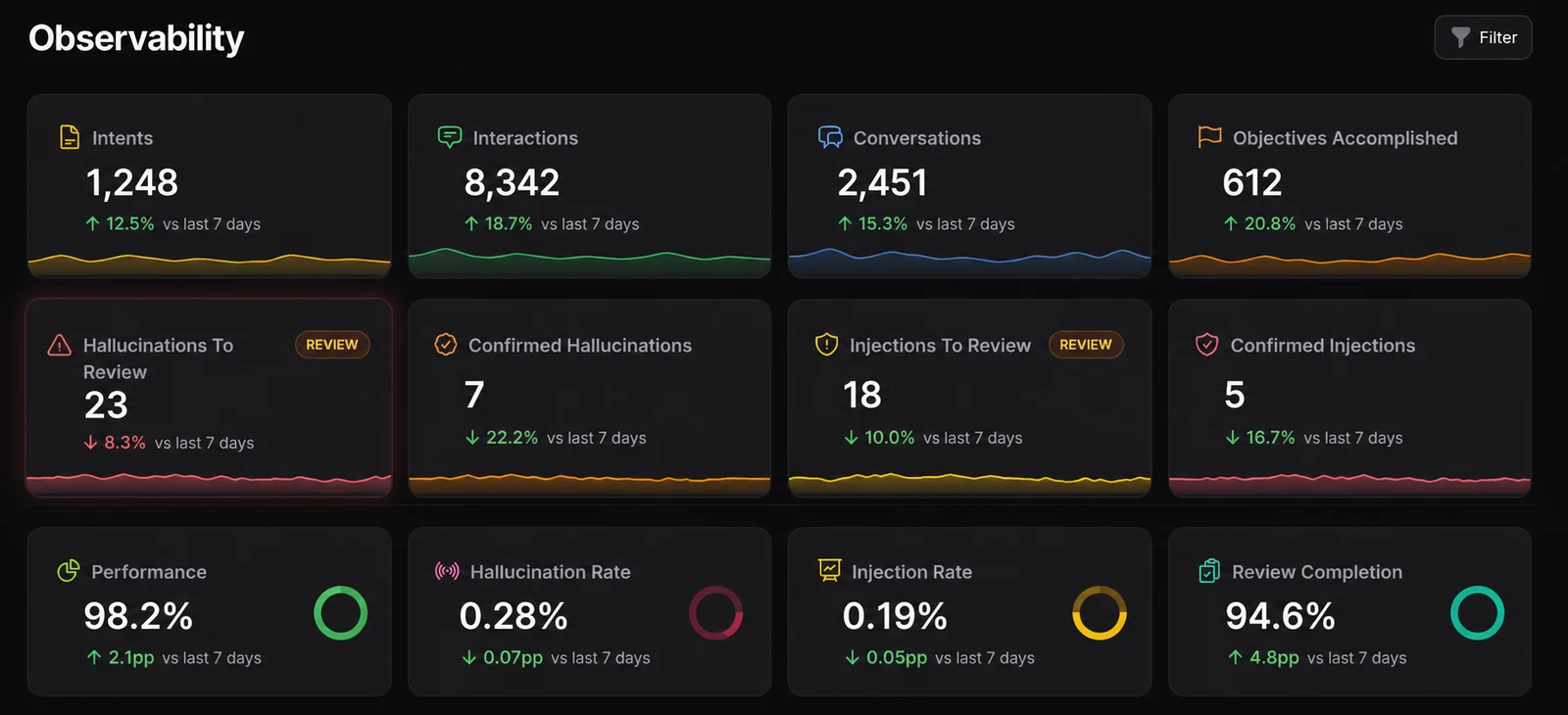
Agents make observability a business requirement
Software teams already understand why observability matters. Logs, metrics, traces, alerts, and incident workflows help teams understand whether a system is healthy and why something changed. AI agents inherit that need, but they add a harder problem: the system is no longer only deterministic software.
An agent can receive the same request twice and produce different outputs. It may retrieve different context, call a different tool, follow a different plan, or stop earlier than expected. A technically successful response can still be wrong, incomplete, too expensive, too slow, or inappropriate for the business process it is supposed to support.
That is why agent observability cannot be reduced to uptime. A 200 response from an LLM endpoint does not mean the agent did the right work. Production teams need to know what the agent saw, what it used, what it decided, what it changed, and whether the result created value.
AI failures often happen quietly
Traditional applications usually fail in ways that are easy to detect: a service is down, a request times out, a job crashes, or a dashboard stops loading. AI agents can fail more quietly. They can answer with confidence while using stale knowledge. They can skip an important tool call. They can summarize a document incorrectly. They can produce an output that looks plausible but misses the operational requirement.
Quiet failures are especially dangerous when agents are connected to real workflows. In a support process, the agent might route the case to the wrong team. In a clinical documentation process, it might miss evidence that affects reimbursement. In a regulatory workflow, it might fail to preserve the traceability needed for review.
The operational risk is not only that the model is wrong. The risk is that the organization cannot see where the wrongness entered the system.
The final answer is only the last mile
Many teams start by monitoring the final response: was it helpful, factual, relevant, safe, and on-brand? Those checks matter. But they are not enough for production agents because the final answer is only the visible end of a longer workflow.
Agent observability needs to follow the process from source to output. That means tracking the user request, the detected intent, the prompt version, the knowledge retrieved, the model used, the tools called, the permissions applied, the latency and cost of each step, the final output, and the downstream outcome.
Without that full path, teams can see that a response was poor but still not know why. Was the prompt weak? Was the source data incomplete? Did retrieval return the wrong document? Did a tool fail silently? Was the model too small for the task? Did the agent choose the wrong branch of the process? Observability is what turns those questions into evidence.
What teams should observe
The exact signals depend on the use case, but production agents usually need visibility across several layers.
- Input and intent: what the user or system asked for, how the request was classified, and which workflow was triggered.
- Context and retrieval: which documents, records, websites, databases, or internal knowledge sources were used.
- Model and prompt execution: prompt versions, model choices, parameters, latency, cost, retries, and errors.
- Tool and system activity: API calls, database queries, browser actions, permissions, approvals, and handoffs.
- Output quality: relevance, factuality, completeness, tone, policy compliance, and usefulness for the workflow.
- Business outcome: whether the agent resolved the request, reduced manual work, improved conversion, saved time, or created measurable operational value.
Evaluations and tracing are the foundation
Two capabilities are especially important: evaluations and tracing.
Evaluations help teams judge output quality at scale. Some checks are deterministic, such as whether a required field is present or whether a response includes a forbidden claim. Others use model-based evaluation to assess dimensions such as helpfulness, relevance, completeness, or whether the answer is grounded in approved context.
Tracing explains how an output happened. A useful trace shows the steps the agent took, the systems it touched, the context it retrieved, and the cost and latency of each part of the run. For teams operating real processes, tracing is not just a debugging feature. It is how they review incidents, answer stakeholder questions, and improve the workflow over time.
Observability should include data, code, systems, and models
A common mistake is to treat observability as something that starts and ends at the model boundary. In practice, many issues that look like model problems are caused upstream or downstream.
The source data may be stale. A document may have been indexed incorrectly. A prompt change may have reduced performance for a specific segment of users. A tool may be returning partial results. A permission rule may be too broad or too restrictive. The model may be performing well, but the surrounding workflow may be weak.
Reliable AI operations require visibility across the whole system: the data layer, the application layer, the prompt and code layer, the connected tools, and the model layer. Agents are systems of systems. Observability has to match that reality.
The goal is not dashboards. The goal is control.
Monitoring is useful only if teams can act on what they learn. A dashboard that shows a rising error rate, higher cost, or lower evaluation score is a starting point. The real value comes from being able to resolve the incident.
That might mean changing a prompt, replacing a knowledge source, disabling a tool, tightening permissions, adding a human review step, moving a workflow to a different model, or creating a new evaluation for a failure mode that was not visible before.
This is where observability becomes operational. It gives teams a feedback loop: observe what happened, understand why it happened, change the system, and measure whether the change improved the process.
How to start
Teams do not need to instrument everything on day one. But they should start with the signals that match the risk of the process. A public website assistant may begin with response quality, unanswered questions, cost, and conversion. An internal operations agent may need tool traces, permissions, approvals, and task completion. A regulated workflow may need evidence history, versioning, and review trails from the beginning.
The important move is to design observability before the agent becomes critical. Pilots can survive with manual review and ad hoc debugging. Production workflows cannot. Once real users, real data, and real business decisions are involved, the question is no longer whether the agent can produce a good demo. The question is whether the organization can operate it responsibly.
AI agents will become more useful as they gain access to more context and more tools. That also makes them harder to understand without the right visibility. Observability is how teams keep that power usable, measurable, and under control.